France Clamps Down on Protesters as Nearly 1,000 Face Arrest
Police deployed heavy resources to prevent a repeat of last week's chaos, resulting in mass arrests and clashes in key cities despite lower violence levels.
By Chloe Zhao ·
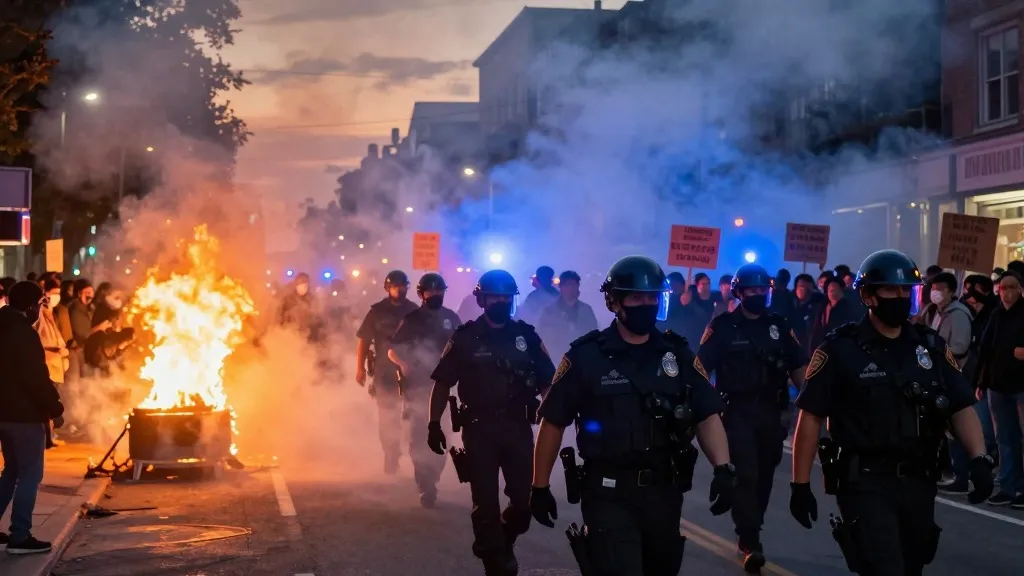
France mobilized a massive security force to manage a new wave of nationwide demonstrations, resulting in close to 1,000 arrests by Saturday night. The protests, driven by grievances over the cost of living and deteriorating school conditions, saw hundreds of thousands of people take to the streets. While the day began with largely peaceful marches, the atmosphere shifted as evening fell. Clashes erupted in several major cities, prompting police to deploy tear gas and water cannon. Authorities indicated that the figure for arrests would likely increase as reports came in from the field.
The scale of the mobilization was significant. The interior ministry estimated that 410,000 people participated, while labor unions claimed the number reached approximately 800,000. To maintain order, roughly 70,000 police officers were deployed across the country. Restrictions were imposed in several urban centers to control the flow of crowds. This heavy presence was a direct response to the disorder of the previous weekend. That earlier event saw officers outnumbered, leading to widespread looting and arson that many consider among the worst disturbances in modern French history.
President Emmanuel Macron had issued a decree earlier in the week limiting demonstrations to those organized by recognized trade unions. This move aimed to streamline the process and reduce the potential for chaos. In the days following the initial unrest, fast-track court hearings resulted in hundreds of convictions for vandalism, arson, and looting. The government sought to balance the right to protest with the need to protect property and public safety. The strategy appeared to yield results on Saturday, as the level of destruction remained lower than the previous week.
In Paris, tensions escalated after a peaceful march from Porte d'Italie toward Porte de Vincennes. Police operations included an elite unit typically reserved for organized crime and counter-terrorism tasks. Some protesters constructed makeshift barricades and threw projectiles at officers. Police charged with batons at groups of masked youths who were smashing windows at a car dealership. Interior Minister Laurent Nuñez stated that several thousand radical activists gathered at the rear of the march. He identified around 500 individuals specifically as rioters, according to reports from AFP.
Other cities experienced their own flashpoints. In Marseille, barricades made of metal sheets and rubbish bins were set on fire to block streets. In Lyon, police used tear gas to disperse a crowd in an area declared off-limits by the local prefecture. One protester, a student, noted that there were about 150 people in the group and visibility was poor due to the smoke. In Bordeaux, onlookers saw individuals tearing boards off a shop, signaling localized frustration. Despite these incidents, the widespread rioting seen a week earlier did not fully return.
Interior Minister Nuñez confirmed late in the day that nearly 1,000 people had been arrested. He also reported two serious injuries, one in Toulouse and another in Clermont-Ferrand. Demonstrators expressed deep frustration with the current economic conditions. A 26-year-old woman in Paris said that people were suffering a lot and that the pressure had become too much. Two masked teenagers felt their generation was being abandoned by the government. One of them acknowledged that looting was not ideal but blamed poverty and police violence for the escalation.
In Orléans, a separate group of about 13,000 people rallied peacefully against the hard-right National Rally party. The unrest also had international implications. Riot police in Tirana, Albania, fired tear gas at anti-government demonstrators. Clashes were reported in Brussels, and in Milan, soldiers and police prevented protesters from gathering to avoid a repeat of recent violence. Last weekend saw about 550,000 people demonstrate, leading to more than 2,500 arrests. Over 2,000 businesses were affected, with damage estimated in the hundreds of millions of euros. With presidential elections six months away, political contenders have begun to blame President Macron and his ministers for the instability.
The next steps for the government involve managing the political fallout and preparing for further demonstrations. The heavy police presence and rapid arrests aim to send a clear message about maintaining order. However, the underlying issues of cost of living and educational conditions remain unresolved. Protesters have indicated that the actions will continue until their demands are met. The balance between allowing civic expression and preventing disorder will likely define the coming weeks in France.
Source: BBC News