Netanyahu Orders Historic West Bank Operation After Hebron Killings
Israeli forces demolished homes in Hebron as the prime minister pledged a military campaign matching the 1967 war scale ahead of national elections.
By Megan Greco ·
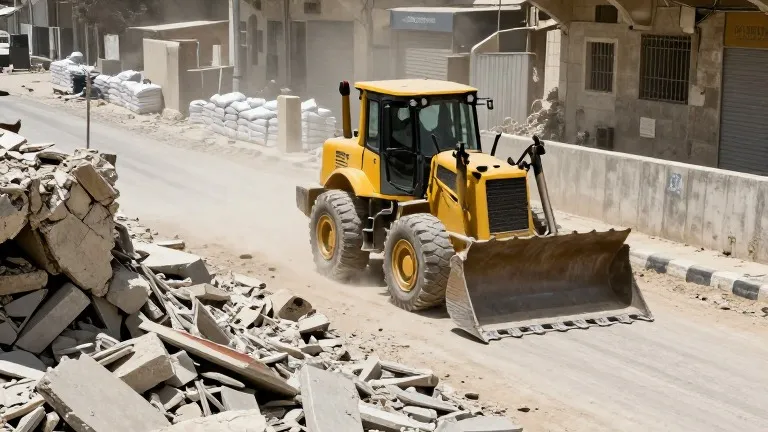
The core conflict in the occupied West Bank has escalated as Israeli forces removed hundreds of Palestinian residents from a neighborhood in Hebron. This action followed a shootout at a nearby checkpoint that resulted in the deaths of two Israeli soldiers and injuries to three others. The immediate response involved heavy machinery leveling structures near the attack site on Friday afternoon.
Prime Minister Benjamin Netanyahu framed the upcoming military response as a fundamental change to the region's status quo. In a televised address delivered from the checkpoint site, he stated that the operation would occur "on a scale not seen since the Six Day War." That conflict, which began nearly 60 years ago, established Israel's initial occupation of the territory. Netanyahu declared the intent to "demolish this place" and change it completely.
The planned operation draws comparisons to last year's assault on two northern West Bank refugee camps. That campaign displaced tens of thousands of people. Human Rights Watch characterized those previous expulsions as war crimes, a label Israel rejected. The current military action has prompted similar concerns from local observers regarding the treatment of civilians.
Context reveals that the Hebron incident occurred during a period of heightened tension and increased land seizures by Israeli settlers. The United Nations Human Rights Office for the occupied Palestinian territory described the environment as a "new level of dehumanization of Palestinians." Israel maintains control through approximately 925 checkpoints, roadblocks, and barriers that restrict movement across the territory. In Hebron, the most populous West Bank city, authorities imposed widespread closures that complicated travel in and around the area.
Military officials provided details on the attack itself, stating that soldiers were positioned behind concrete barriers when two gunmen opened fire. The exchange lasted roughly 20 minutes before troops killed the attackers. The timing of this response aligns with national elections scheduled for October 27. Polls indicate that Netanyahu and his main rival, Gadi Eisenkot, are competing closely, with neither currently holding enough support to form a government.
Danny Citrinowicz, a senior researcher at the Institute for National Security Studies in Tel Aviv, argued that the scale of the response is driven by electoral strategy. He noted that Netanyahu aims to present himself as the primary security figure to voters. Citrinowicz described the eviction of families from the attackers' neighborhood, absent evidence linking them to the gunmen, as "collective punishment."
Citrinowicz urged authorities to focus on arresting specific individuals while supporting the broader population. He argued that preventing future attacks requires providing stability, a working economy, and hope rather than relying solely on harsh measures. The military operation proceeds as the political stakes rise in the weeks leading up to the vote.
Source: NPR