European Youth Unleash Widespread Protests Across Nine Nations
Students and young workers have taken to the streets from Lisbon to Athens, driven by grievances over housing costs, education, and social inequality, with fresh demonstrations scheduled for France and Italy.
By Chloe Zhao ·
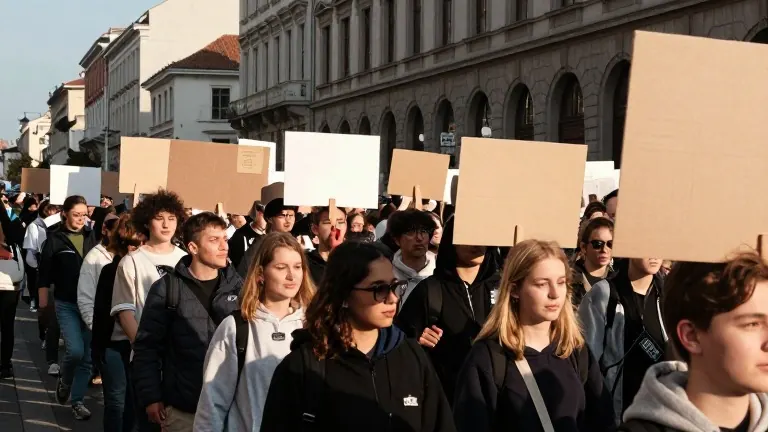
Young people across Europe have turned their frustration into mass street protests that have spread from the Iberian Peninsula to the Balkans. What began as student rallies in France in late September has expanded into a continent-wide movement involving students in Belgium, Ireland, Spain, Portugal, Italy, Greece, Serbia, and Albania. While many marches remain peaceful, others have devolved into clashes with police, looting, and the use of tear gas.
The unrest began in France, where students cited staff shortages and poor building conditions as primary grievances. The movement quickly crossed borders. In Belgium, the capital and the town of Liège experienced weeks of protests after the French example inspired local students. In Spain, a tent encampment has occupied a central square in Madrid since late September. In Lisbon, tens of thousands marched earlier this month, while in Albania, demonstrators are demanding that Prime Minister Edi Rama, who has served for 13 years, resign over corruption allegations.
The current wave is distinct from previous European protests because of its scale and the age of the participants. In Barcelona, more than half of those detained in recent clashes were under the age of 18. Italian news agency LaPresse reported that minors were also among those apprehended in Milan. Organizers have utilized social media platforms like TikTok and Instagram to coordinate events, a trend that led Belgium’s interior minister to describe the phenomenon as the 'TikTokisation' of protests.
Economic pressure is a central driver of the movement. Young protesters express fear that rising living costs will prevent them from finishing their education or securing housing. In Lisbon, Carolina Cruz, a 26-year-old PhD student, told Reuters that she faces losing her home as her rental contract nears expiration, noting that she is the first in her family to enter a doctoral program yet still struggles to make ends meet. In Milan, 22-year-old protester Riccardo told AFP that the goal is to force public discourse on these issues, even if the demonstrations do not reach the level of disruption seen in France or Spain.
Political analysts suggest that these demonstrations are the result of overlapping crises that have remained unresolved. Mark Leonard, director of the European Council of Foreign Relations, stated that the financial crisis of 2007, the migrant crisis of 2015, the environmental crisis, the pandemic, and inflation following Russia’s invasion of Ukraine have layered onto one another. He noted that social media algorithms have hardened perspectives, creating a sense of polarization where groups view their specific crisis as more important than others.
Nathalie Tocci, a politics professor at Johns Hopkins University, argued that the engagement of young people should not be surprising. She pointed to the student-led movement in Serbia that recently defeated leader Aleksandar Vučić in parliamentary elections. Tocci stated that young people are politically engaged in a grassroots manner, similar to the Fridays for Future climate movement and the demonstrations against Israel’s actions in Gaza following October 7.
Violence has accompanied the peaceful marches, leading to thousands of arrests. Intelligence services in France and Belgium described looting as opportunistic, while identifying some rioting as orchestrated by ultra-left radical groups. In France, the political right, including President Emmanuel Macron, blamed left-wing radicals and 'delinquents' for the disorder. In Belgium, the anti-immigration party Vlaams Belang described the riots as 'imported,' blaming a failure of integration, while Interior Minister Bernard Quentin pointed to ultra-left groups as the primary instigators.
Governments are implementing stricter penalties in response. Italy and France have promised to enforce a 'you break it, you pay for it' policy for rioters. Italian Prime Minister Giorgia Meloni has moved to make parents of minors liable for damage caused by their children, including the potential deduction of welfare support. France’s Civil Code already holds parents liable for damages caused by their children living in their households.
Fresh mass demonstrations are planned for France and Italy in the coming days. All major European Union countries are holding or will hold key elections in the next several months, with France’s presidential vote approaching. The timing of these elections has raised questions about how governments will balance listening to protester concerns with maintaining law and order to appeal to older voters.
Source: BBC News