
Andreas Nieder finds carrion crows process visual data at double primate speed
New research demonstrates that avian brains achieve complex decision-making outcomes without a neocortex.
By Megan Greco ·
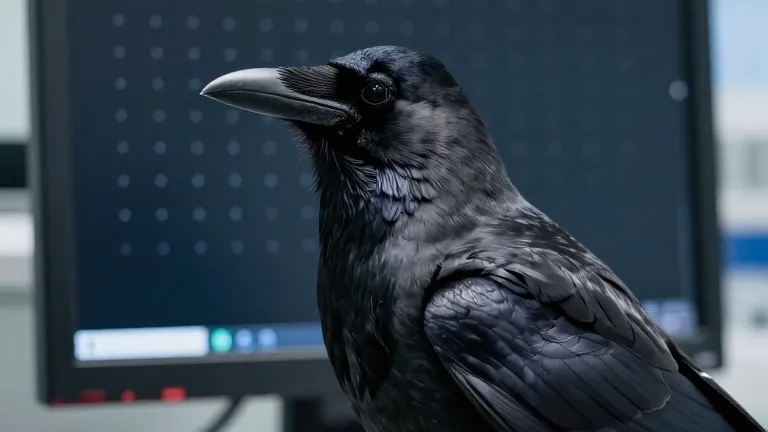
Andreas Nieder, a neurobiologist at the University of Tübingen, and his colleague Philipp Schmidbauer have demonstrated that carrion crows solve complex visual tasks at twice the speed of monkeys. The study challenges long-held assumptions about the neurological requirements for high-speed decision making.
The researchers subjected two hand-raised carrion crows to a random-dot-motion task previously used to study primate cognition. In this experiment, a cloud of flickering specks drifts weakly in a specific direction. Subjects must determine the direction of movement and commit to a choice. In primates, this process relies on the neocortex, where neurons collect visual evidence until their firing rates cross a specific threshold.
Birds lack a neocortex, which created a gap in scientific understanding regarding how avian brains encode decisions. Nieder described this as the central question of the study, asking how a differently organized brain could handle similar cognitive demands. To ensure a direct comparison, the team kept the experimental setup identical to the monkey version.
The crows sat in front of a touch-sensitive monitor displaying white dots on a black background. Some fraction of the dots drifted together to the left, right, up, or down. The birds reported their answer by pecking one of the targets flanking the display. A correct selection earned a mealworm. Nieder noted that the primary difference between the two species was the method of response, with crows pecking and monkeys making eye movements.
The researchers varied task difficulty by adjusting the percentage of dots moving coherently. The easiest condition involved 81 percent of dots moving together, while the hardest involved only 3 percent, a level barely distinguishable from noise. The team also included a zero percent condition where no correct answer existed. Despite these variations, the crows applied the same mathematical logic as primates to reach their decisions.
The findings indicate that the absence of a neocortex does not prevent a brain from arriving at decisions through a comparable process. Instead, the avian brain utilizes a different structural organization to achieve the same outcome. The speed advantage suggests that the specific architecture of the neocortex is not the sole determinant of decision-making velocity in vertebrate brains.
Source: Ars Technica